Water Erosion and Soil Health
Soil or “dirt” dictates the foundation and health of all life forms, be it within the terrestrial or aquatic systems. Strong soil structure provides the basis for food, fuel, fiber and shelter, along with maintaining environmental integrity. Soil functions can range from filtering pollutants, retaining nutrients, sequestering carbon, and promoting biodiversity.
Unfortunately, soil remains highly prone to degradation and erosion, either through natural means or anthropogenic activities. Degraded soils erode quicker, polluting waterways, creating deserts and weakening soil fertility. Soil conservation focuses on keeping soil in its place and maintaining its multifaceted functionalities.
Water, wind, tillage farming, and land clearing accelerate soil erosion. Water erosion in particular, can remove and redistribute large amounts of soil via precipitation, runoff, snowmelt, or irrigation. This post describes the different types and processes of water erosion, along with the soil properties that enable water erosion.
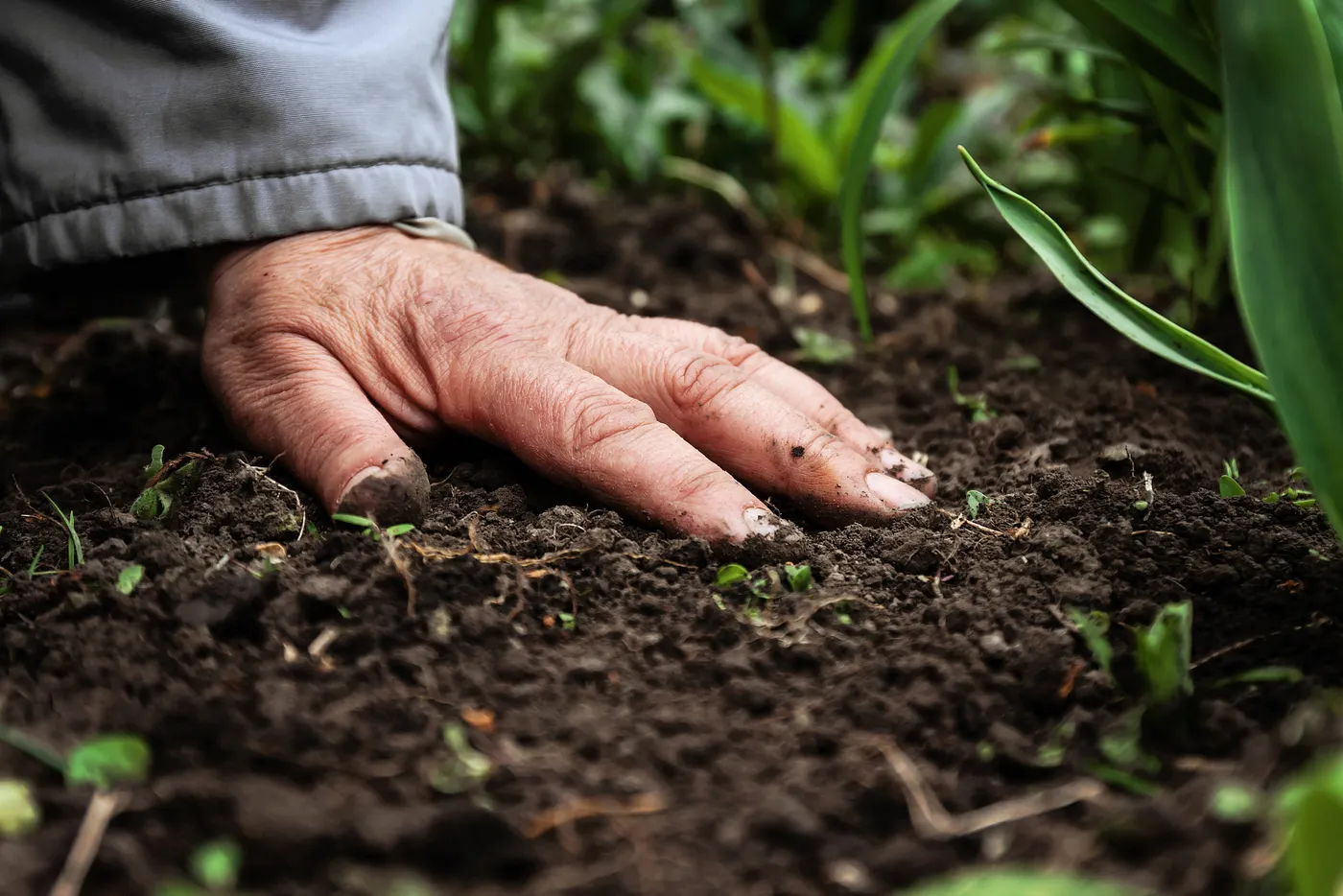 Retrieved from: https://www.agriland.ie/farming-news/the-release-of-nutrient-reserves-in-soil-a-pda-perspective/
The Detrimental Effects of Water Erosion
Water picks up soil particles and moves them towards lower landscapes or into aquatic systems. Soil particles can clog waterways and smother aquatic life. Soil may also carry different pollutants such as nutrients (nitrogen and phosphorus), salt, chemicals, radium, industrial waste or urban runoff.
Excess nutrients in waterbodies can increase eutrophication, a phenomenon where algae absorbs soil nutrients and grows excessively, blocking sunlight and warmth for other organisms. When this excess algae dies, microorganisms use more oxygen to decompose it and end up depleting oxygen for other organisms. Radium, salt and chemical pollutants also lead to a decline in species diversity and water quality.
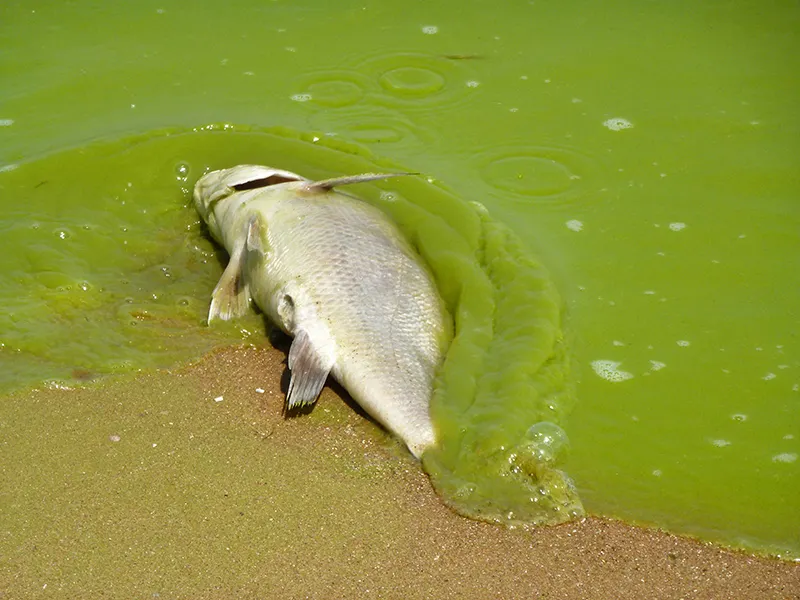 Eutrophication. Retrieved from: https://www.michiganseagrant.org/lessons/lessons/by-broad-concept/physical-science/dead-zones/
Heavy rainfall also compacts soil and affects drainage, providing a smoother surface for runoff and particle transport. Additionally, excessive rainfall clogs soil pores, reduces infiltration and hinders nutrient uptake by plants, thus impacting crop yield and vegetative growth.
Types of Water Erosion
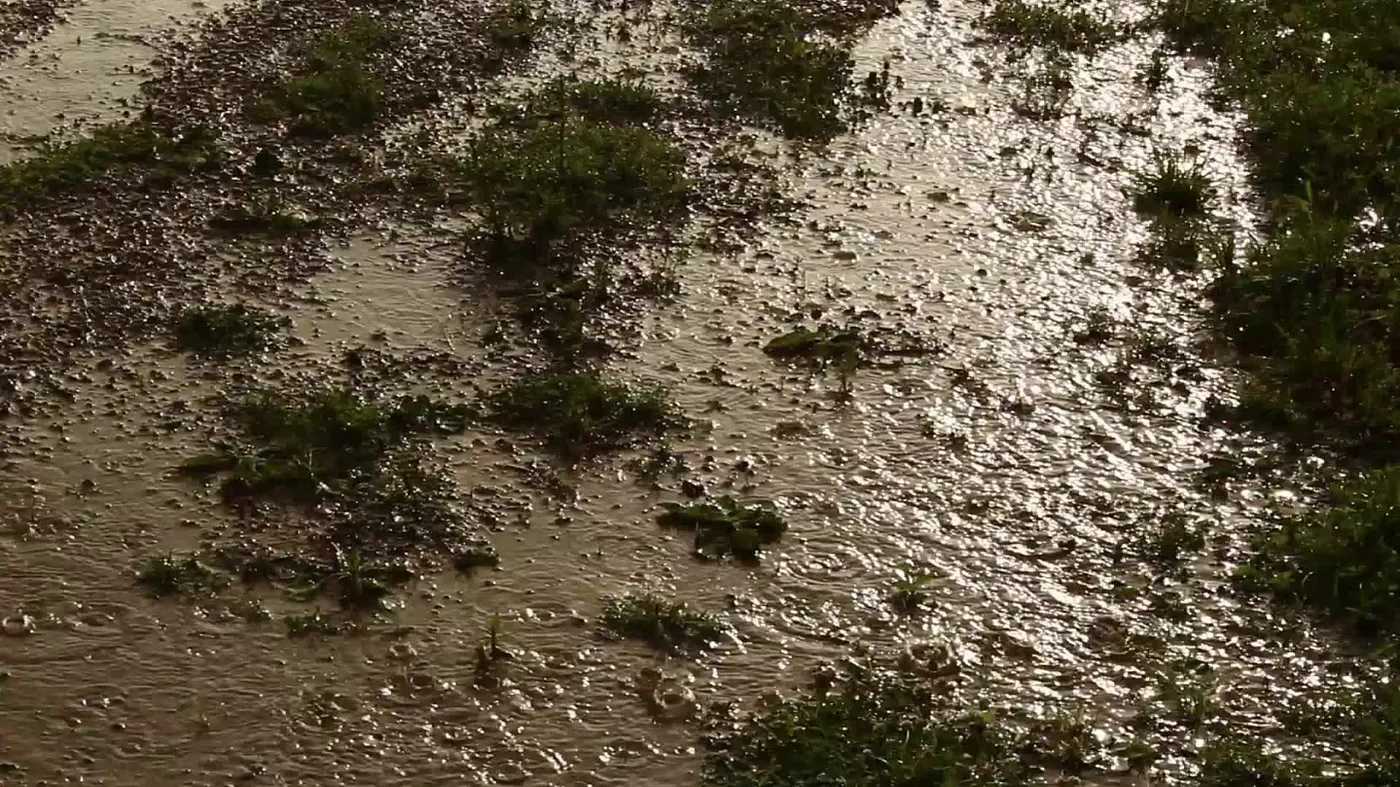
Splash Erosion: Normally acting as the first stage of water erosion during rainfall, splash erosion occurs when raindrops strike the ground and splash against the soil. The splashing impact breaks up soil particles and forms craters and cavities. Craters cause the soil to become rough and crusty, hindering infiltration and plant growth. Reduced infiltration leads to excess water accumulation on the soil surface, thus accelerating runoff and erosion.
The depth of these craters depends on raindrop velocity, size and shape. These craters influence soil erosion, eventually sculpting adjacent soil, stones, rocks and vegetation.
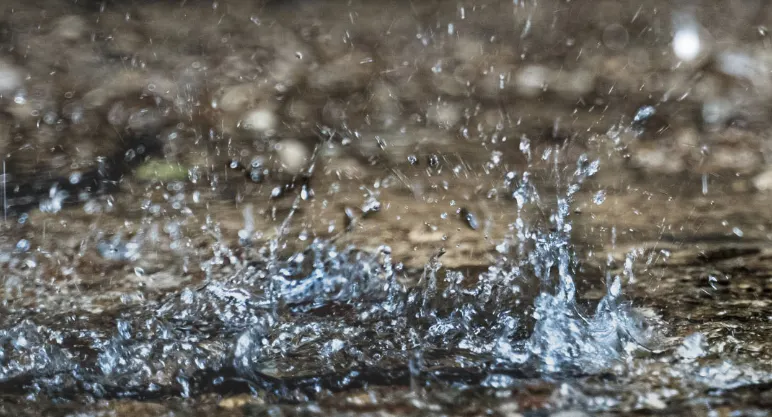 Retrieved from: https://goseed.com/6-types-of-soil-erosion/
Interrill or Sheet Erosion: After making a splashy entrance, rainfall begins to runoff over the surface as part of interrill or sheet erosion. During interrill erosion, runoff flows downhill and carries a shallow sheet of water along with dislodged soil particles. Interrill erosion occurs simultaneously with splash erosion, and together, they account for about 70% of soil erosion. Interrill erosion is a function of particle detachment, rainfall intensity, and field slope.
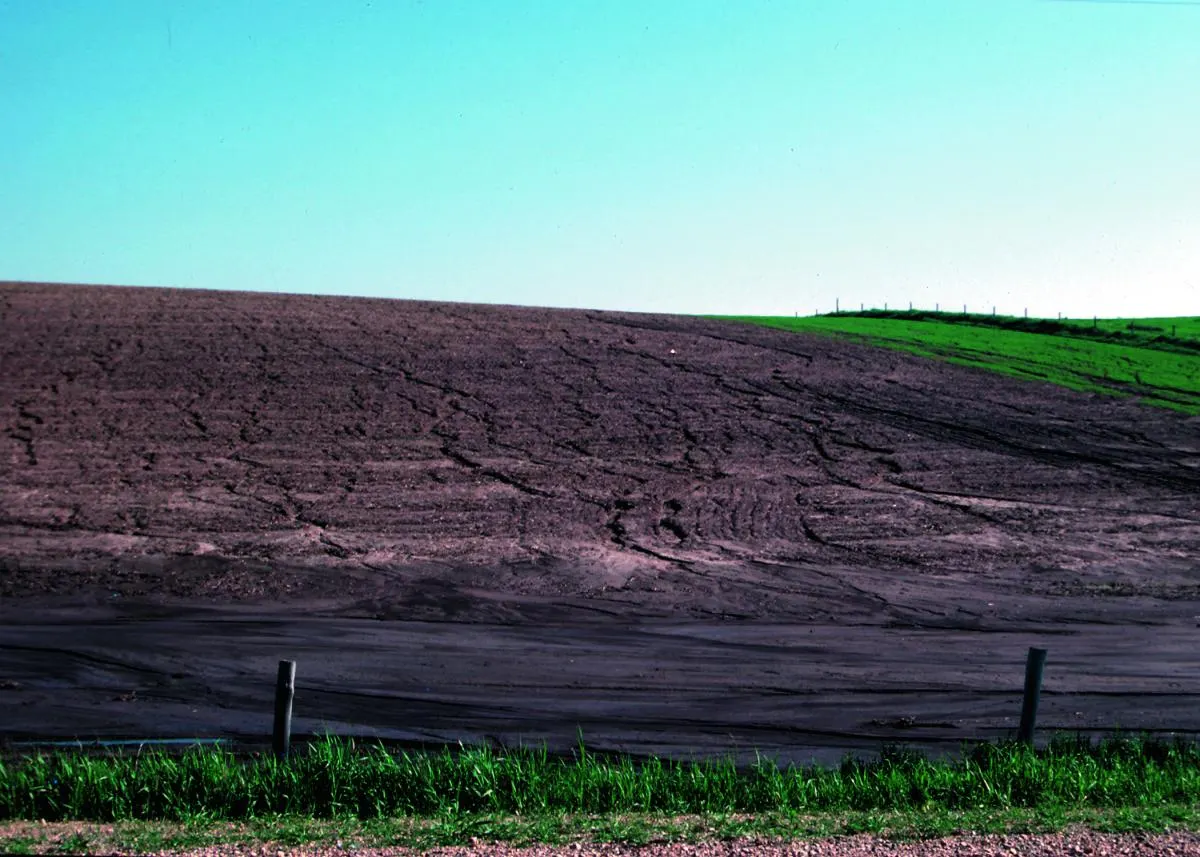 Retrieved from: https://agbmps.osu.edu/scenario/inter-rill-and-rill-erosion
Rill Erosion: Eventually, runoff may create “rills” or channels along the soil surface, providing a more concentrated path for water to flow. Soil erosion occurs at a faster rate during rill erosion than interrill erosion. Rill erosion is a function of soil erodibility, runoff transport capacity, and the hydraulic shear of water flow.
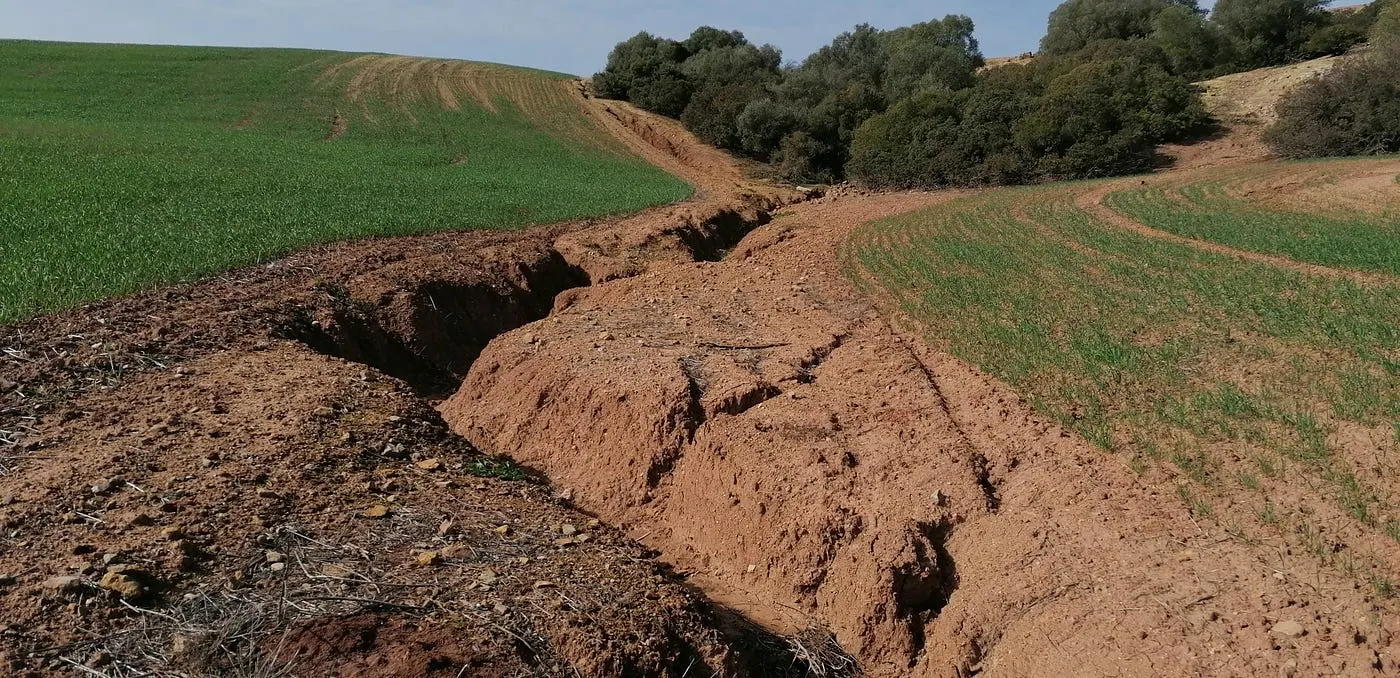
Gully Erosion: Seen as an extension of rill erosion, gully erosion forms deeper U-shaped or V-shaped channels, measuring at least 0.3m in width and 0.3m in depth. Gullies develop from concentrated runoff converging in the lower areas of a field. Continuous gully erosion has been known to remove entire soil profiles, transporting significant amounts of sediment.
Gully formation depends on the shear stress of flowing water and the critical shear stress of soil. Shear stress refers to the force of friction from moving water hitting against the bottom of a channel or flow path. Shear stress influences soil detachment and transport of eroded materials. Critical shear stress is the stress at which soil particles begin to detach. Critical shear stress is a function of soil texture, bulk density, clay content, plant roots and soil slope. Gullies begin to develop when the shear stress of water flow exceeds the critical shear stress of soil.
 Retrieved from: https://medium.com/@ecochatters/combating-gully-erosion-strategies-for-environmental-preservation-314719eccc75
Tunnel Erosion: Common in arid and semi-arid areas, tunnel erosion involves the removal of subsurface soil, as runoff flows beneath the surface, as though in a tunnel. Channel runoff, natural cracks and animal burrows allow water to infiltrate the surface and remove highly erodible and loose soils. As water accumulates, the tunnels expand and form potholes and gullies, eventually changing the structure and hydrology of the land.
Streambank Erosion: Lastly, runoff can collapse river and stream banks, resulting from the shear stress of water flow, the slope of the land, and soil erodibility factors. Anthropogenic or human influences such as unsustainable land development, grazing, and agriculture can also accelerate streambank erosion.
The Water Erosion Process
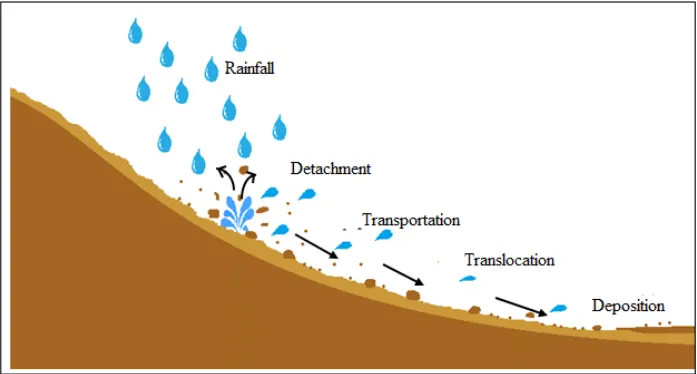
The water erosion process follows three steps involving detachment, transport and deposition of soil particles. As raindrops hit the surface, soil particles detach and aggregates land on top of the surface, forming a kind of seal and plugging the soil pores. Plugged pores reduce infiltration and cause runoff.
Smaller or finer particles such as clay are easier to remove as part of runoff. Runoff and erosion leaves behind coarse soil particles with less porosity and infiltration to support plant growth. Coarser soil also gives way for potential flooding and landslides. Runoff transports detached soil particles and deposits them at the bottom of a slope or into waterways.
 The water erosion process. Retrieved from: https://www.researchgate.net/figure/Mechanism-of-water-erosion-117_fig2_315888051
Climate, vegetative cover, topography and soil properties impact the water erosion process. For example, more precipitation will lead to more erosion. Low precipitation will impede plant growth. Vegetation, trees and roots filter particles and reduce erosion. A steeper slope will exacerbate runoff, while soil properties such as texture, aggregation, porosity and compaction will also govern soil detachment.
Soil erosion is a function of agent erosivity times the soil erodibility. Agent erosivity includes rainfall and runoff capacities, while soil erodibility describes different soil characteristics such as texture, aggregation, water content etc.
Agent Erosivity
Erosivity refers to the potential of rainfall or runoff to detach and erode soil. Erosivity can be divided into two categories, the first being rainfall erosivity and the second being runoff erosivity. Rainfall has a higher ability to produce soil erosion than runoff.
Rainfall Erosivity
Rainfall erosivity represents the ability of raindrops to initiate soil erosion. Rainfall erosivity depends on the amount, intensity, terminal velocity, and the drop size of rain.
A higher amount of rain results in more erosion. Intensity is measured by determining the amount of rain within a time period. Intense storms usually occur in short durations but cause high amounts of erosion. Terminal velocity refers to the constant speed at which a raindrop falls, until gravitational force equals air resistance. Terminal velocity increases with larger raindrops. Erosive power increases with larger raindrops and higher terminal velocity.
The kinetic energy of a moving raindrop is a function of the raindrop size and its terminal velocity. The rainfall erosivity index, EI30, is a common measure of how rainfall affects soil erosion based on rainfall intensity. The ‘E’ refers to the kinetic energy of a storm and the ‘I30’ describes the peak rainfall intensity in a 30-minute period.
 Retrieved from: https://www.pond5.com/stock-footage/item/26110217-heavy-rain-mud-and-grass
Runoff Erosivity
Runoff erosivity can be defined as the ability of runoff to cause soil erosion. Runoff occurs when water fills up soil pores and ends up accumulating on the surface, flowing downhill or into waterbodies. Runoff detaches soil particles while flowing downhill. It also carries detached or loose particles away from their origin. Runoff equals the input (rain, snowmelt, irrigation), minus the output (infiltration, evaporation, rain interception by plant canopies, etc.).
Runoff amount, velocity and turbulence together determine the capacity of runoff to break soil particles. Runoff can be estimated through different parameters, including the time of concentration, runoff volume, hydrologic groups, and the peak runoff rate.
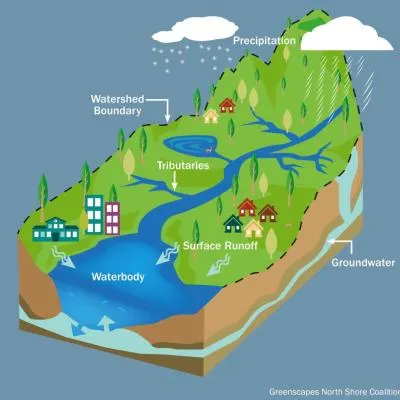
When rain falls on a watershed, it takes a certain amount of time to flow into an outlet, such as a stream, lake, or ocean. The time of concentration refers to the time it takes for water to travel from the farthest point of a watershed into an outlet.
 A watershed. Retrieved from: https://www.fisheries.noaa.gov/new-england-mid-atlantic/habitat-conservation/what-watershed
Surface roughness, watershed slope, watershed size, and the length and shape of the channel determine the time of concentration. For example, smoother surfaces and steeper slopes result in a shorter time of concentration. Larger watersheds increase the time of concentration, while straight, sloping and smooth channels shorten the time of concentration.
Rainfall volume is a function of the amount of rainfall per day, depth of runoff, and surface water storage via interception by plants, evaporation, infiltration and ponding.
Outside of rainfall and water, runoff erosivity can also increase based on various soil properties. Hydrologic soil groups include four different classifications (A, B, C, and D) for soils having the same runoff potential, given similar rainstorms and surface cover conditions.
Group A soils comprise of sandy soils, representing high permeability, infiltration, and saturated hydraulic conductivity and thus having the lowest runoff potential. Saturated hydraulic conductivity refers to the ability of soil to conduct water under saturated conditions. Group D on the other spectrum, contain clayey soils that have low permeability, infiltration rates and saturated hydraulic conductivity, resulting in the highest runoff potential.
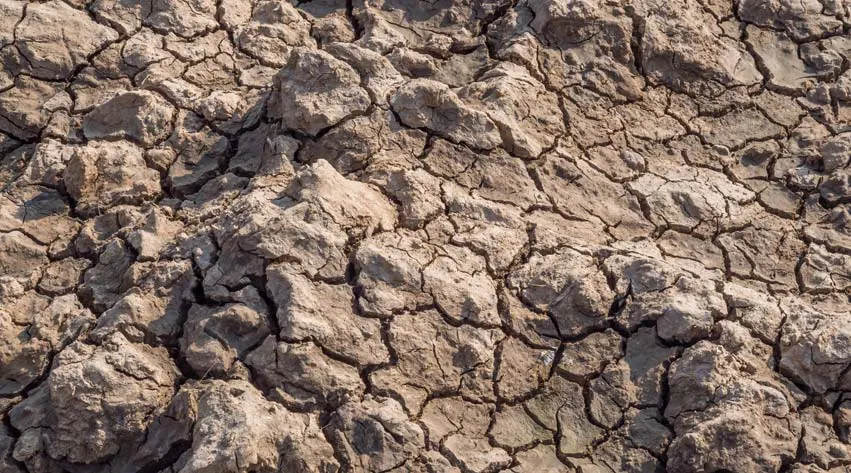 Clayey soils. Retrieved from: https://www.notcutts.co.uk/garden-advice/plants-for-purpose/clay-soils/
Soil Erodibility
Erodibility refers to the soil’s susceptibility to erosion. Soil properties such as texture, structure, aggregate attributes, soil organic matter content and soil water content, all determine the fate of soil erodibility.
Texture: The texture, as in the sand, silt, or clay content, influence soil detachment and water infiltration. Soils with high sand or silt content detach more readily than clayey soils. However, clayey soils are more prone to being transported easily during runoff once detached, due to their fine particle size. Water infiltration is also higher in sandy soils, making them less resistant to erosion.
Structure: The soil structure includes pore size and aggregate stability, along with microorganism and plant root habitat. Soils with poor structure are susceptible to detachment, compaction and runoff. Parameters such as water infiltration, air permeability and organic matter content can all indicate the structure of soil.
Aggregate Attributes: Aggregation occurs when soil particles adhere to each other more strongly than to other particles around them. Aggregate attributes such as stability, tensile strength, bulk density and wettability determine the magnitude of soil erosion. The ability of an aggregate to withstand the impact of a raindrop will affect soil erodibility. Aggregate stability is a function of soil texture, soil organic matter content, cation exchange capacity and cementing agents. Tensile strength refers to the force required to break an aggregate. High bulk density indicates compaction and low soil porosity, hindering water infiltration. Wettability refers to the soil’s ability to absorb water.
Soil Organic Matter (SOM): A small portion of soils contain soil organic matter (SOM), which consists of plant and animal residue in the process of being decomposed by microorganisms. Carbon makes up about 50% of SOM weight, with the remainder being oxygen, hydrogen, nitrogen, phosphorus, and sulfur. SOM enhances the soil’s cation exchange capacity, increases water holding capacity, and promotes particle binding, thus stabilizing aggregates and reducing runoff. CEC refers to the amount of cations, or positively charged ions, the soil can store on the surface of its particles. The negatively charged soil and SOM hold cations such as calcium, potassium, copper, sodium, magnesium etc., in order for plants to uptake these nutrients or materials.
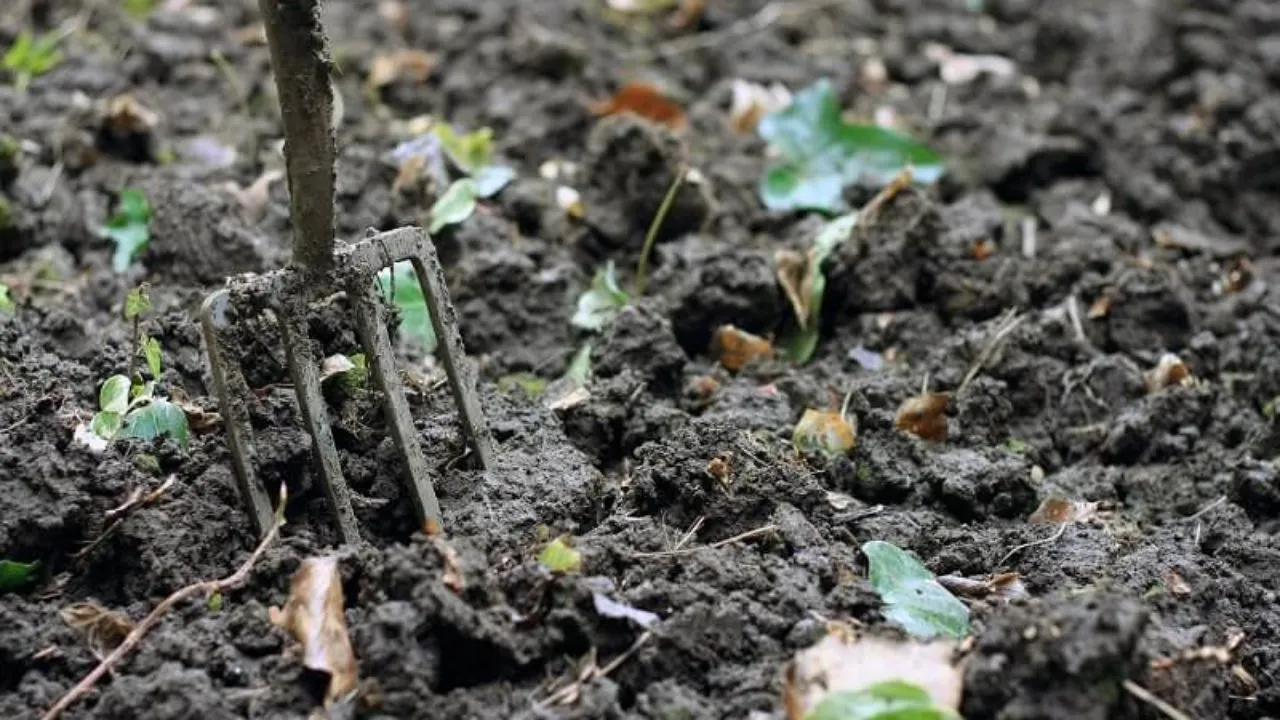 Plant residues making up SOM. Retrieved from: https://www.agqlabs.us.com/organic-matter-in-soils/
Soil Water Content: Wetter soil impedes pores from absorbing rainwater, leading to surface accumulation and runoff. Too little water also weakens soil and makes it more susceptible to detachment and runoff.
Vegetation as a Control
Understanding the factors and processes of water erosion can help determine proper protective measures for soil conservation. Measuring runoff can help design erosion controls, establish vegetative buffers, and estimate pollutant transport in runoff.
Vegetative cover can provide a variety of benefits to combat water erosion. Plant roots absorb water, intercept runoff, uptake nutrients, and filter pollutants. Vegetative cover prevents erosion by stabilizing soil structure, increasing soil organic matter and increasing surface roughness. They can resist the energy and impact of raindrops, creating a sponging effect and reducing raindrop bounce and soil detachment during splash erosion.
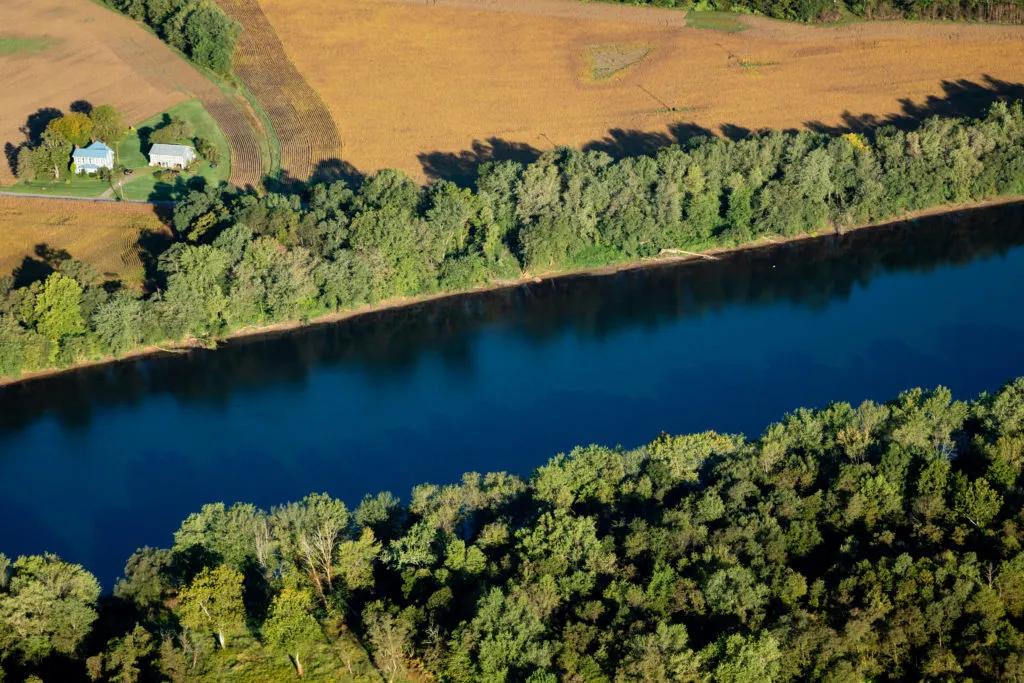 A riparian buffer. Retrieved from: https://paparksandforests.org/what-is-a-riparian-forest-buffer-and-why-should-you-care/
Vegetative buffers can contour riparian zones, roads, farms, construction sites and other polluting sources or areas of erosion. On farms, best management practices such as cover crops and agroforestry can help strengthen soil structure, reduce compaction, and slow soil erosion.
Plant height, canopy and root depth shape the effectiveness of vegetative cover as an erosion control. Drawbacks may include its limited success in areas with steep slopes and extreme weather conditions.
Summary
Water erosion contributes a great amount towards the health of soil and its functionalities. Rainfall and runoff accelerate erosion, affect soil integrity and damage environmental quality. Rainfall detaches soil and runoff transports and deposits soil particles in lowlands and waterbodies. Detachment and erosion leaves crusty and rough soil behind, reducing water infiltration and further enhancing runoff. Climate, vegetation, topography and soil properties indicate water erosivity and soil erodibility. Vegetation can intercept runoff, filter pollutants and improve soil health.
Soil conservation provides a strong base for addressing major health concerns, including agriculture, carbon storage, air filtration, water purification, shelter and biodiversity.
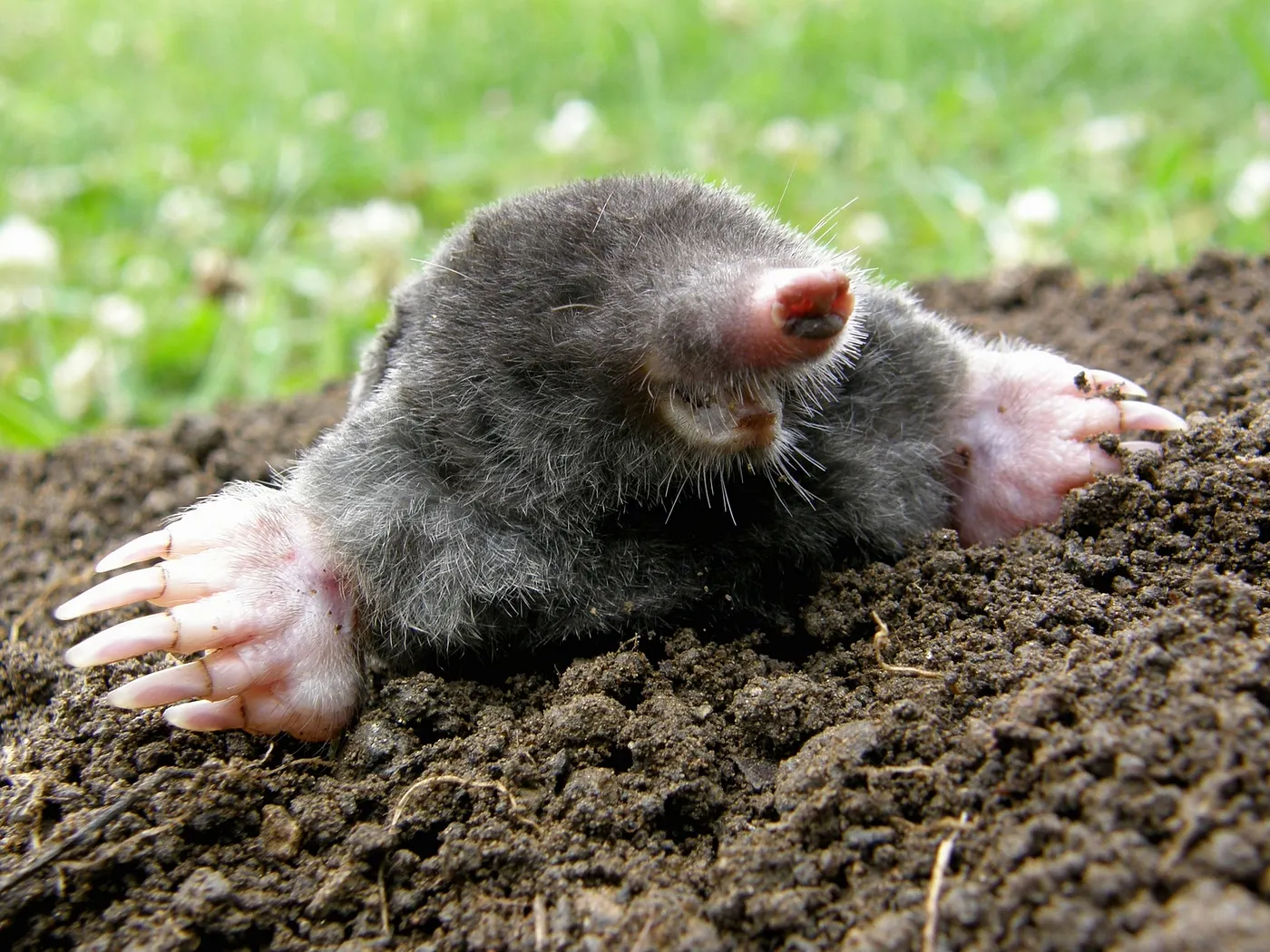 Retrieved from: https://www.umweltbundesamt.de/en/topics/soil-land/soil-science/soil-functions
References
-
Al-Kaisi, M., & Hanna, M. (n.d.). Spring rain and soil erosion. Iastate.edu. Retrieved May 23, 2024, from https://crops.extension.iastate.edu/encyclopedia/spring-rain-and-soil-erosion
-
Begum, T. (n.d.). Soil degradation: the problems and how to fix them. Nhm.ac.uk. Retrieved May 23, 2024, from https://www.nhm.ac.uk/discover/soil-degradation.html
-
Blanco, H., & Lal, R. (2010). Principles of soil conservation and management (2008th ed.). Springer.
-
Fernández-Raga, M., Palencia, C., Keesstra, S., Jordán, A., Fraile, R., Angulo-Martínez, M., & Cerdà, A. (2017). Splash erosion: A review with unanswered questions. Earth-Science Reviews, 171, 463–477. https://doi.org/10.1016/j.earscirev.2017.06.009
-
Understanding Soil Compaction. (n.d.). Rutgers.edu. Retrieved May 23, 2024, from https://ocean.njaes.rutgers.edu/anr/understanding-soil-compaction/